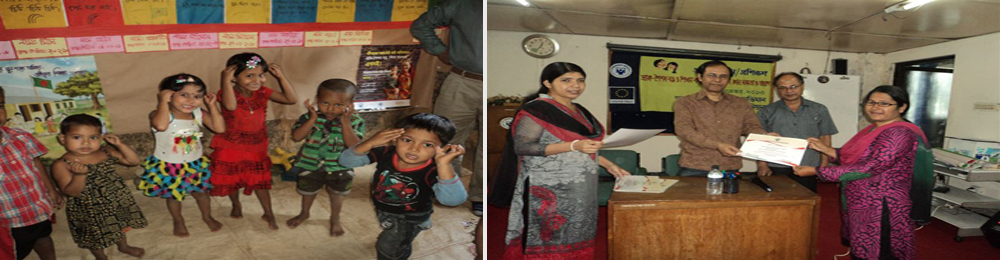
An orientation titled “Knowledge, Skill on Practice on Early Childhood Care and Education (ECCE) was held on 17 to 22 November, 2013 at the CAMPE Training Centre, Dhaka. The course was organized to orient the participants on the importance of early childhood development and enhance their knowledge and skills to establish Early Learning Centre at their working areas. A total of 24 participants including 16 female from different organizations like Wave Foundation,; Swanirvar Bangladesh, SDSL, PASA, BSKS, IER- Dhaka University, Save the Woman and Children; Caritas Bangladesh attended the course.
The major discussant topics of the orientation were- Child Rights, Concept and areas of growth and development; Age-wise development milestone; Interactive care- scope and challenges; Importance of play for holistic child development; Uses of materials; Parenting; ECCE initiatives in Bangladesh; Health and Nutrition in early childhood care and education. Field visit and Story telling for children were included in the course.
The course was facilitated by Tapon Kumar Das associated with Mosharraf Hossain and Tanuja Sharma of CAMPE. While Professor Dr. Md. Asirul Hoque, PhD, Bangladesh Institute of Health Sciences (BIHS); Md. Tariqul Islam Chowdhury, Bangladesh Sishu Academy; Ms. Janatun Nahar, IED-BU; Ms Tahamina, Lalmatia Collage took part in the course as external resource persons.
At the end of the course participant prepared an Action plan to extend their support in early stimulation. Some of the participant made opinion that this orientation is necessary for all parents before their child birth. It is also important for all teacher engaged in different kindergarten and pre-primary education centre.
At the closing participants were awarded with certificate.
A Division Bench of the High Court comprising Madam Justice Naima Haider and Mr Justice Zafar Ahmed made the Rule Absolute in Part today by directing the Government to ensure that the Private Schools across the country follow prescribed ceiling on such fees fixed by the Ministry of Education under নিমà§à¦®à¦®à¦¾à¦§à§à¦¯à¦®à¦¿à¦•/ মাধà§à¦¯à¦®à¦¿à¦•/মাধà§à¦¯à¦®à¦¿à¦• ও উচà§à¦š মাধà§à¦¯à¦®à¦¿à¦• পরà§à¦¯à¦¾à§Ÿà§‡à¦° বেসরকারি শিকà§à¦·à¦¾ পà§à¦°à¦¤à¦¿à¦·à§à¦ ান সমূহ à¦à¦°à§à¦¤à¦¿à¦° কà§à¦·à§‡à¦¤à§à¦°à§‡ অনà§à¦¸à¦°à¦¨à§€à§Ÿ নীতিমালা -২০১১ and also take stern action to prevent schools charging excessive admission fees across the country. Quoting the report submitted on behalf of the Government, the Court observed that the Ministry of Education had issued show cause notices to a few schools in Dhaka who were allegedly taking excessive payments beyond the ceiling. The Court noted that after issuance of the show cause notice, those schools stopped taking such payments from the guardian of students as admission fees and they also gave assurances that such amounts would be adjusted against other dues. As those schools had eventually complied with the aforesaid guidelines, the Court would not direct further immediate action against them.
However, the Court issued a “Continuous Mandamus” order upon the authorities, directing the government to ensure that the aforesaid guidelines are being followed strictly by the private schools across the country and warning that non –compliance by any school would render them liable to being held in contempt of court.
The first petitioner, former Adviser to the Caretaker Government, and the Executive Director of the Campaign for Popular Education (CAMPE) welcomed the judgment, commenting that “The right to education is a fundamental right of a citizen of Bangladesh and thus it is the duty of the State to ensure education to all citizens. This judgment will add a new dimension to the movement for education rights, and establishment of the rights of people who are deprived of education”
Earlier on 10th of January, 2102 a High Court Bench comprising of Mr. Justice AHM Shamsuddin Choudhury Manik and Mr. Justice Jahangir Hossain Selim issued a Rule Nisi after hearing a writ petition jointly filed by the Campaign for Popular Education (CAMPE) and Bangladesh Legal Aid and Services Trust (BLAST). The writ challenged the government’s failure to prevent the primary, secondary and higher secondary educational institutions (which receive MPO) from charging additional admission fees from guardians of students. The HC issued a Rule upon the education ministry, directorates and boards of education to explain in three weeks why their failure to investigate the imposition of excess school fees and charges from guardians in the form of donations, and its failure to prosecute and punish the schools and colleges doing so should not be declared unconstitutional and a violation of the access to education.
The Court asked the officials to explain why they should not be directed to adopt a time-bound action plan to monitor both government and non-government schools to ensure that they comply with the guidelines regarding the fee ceiling and refund the excess fees extracted from guardians.
The petition was filed following a spate of news reports about a number of schools across the country charging admission fees ranging from Tk 8,000 to Tk 32,000 or even higher unlawfully.
According to an Education Ministry circular, admission fees for such schools had been fixed at Tk 5,000 to Tk.8000 for the Dhaka Metropolitan area, Tk 3,000 for other metropolitan areas, Tk 2,000 for district headquarters, Tk 1,000 for upazila headquarters and Tk 500 for rural areas according to the petition.
Barrister Ashraful Hadi appearing for the petitioners stated: “this is a landmark judgment that will facilitate proper access to education as part of fundamental rights of every citizen. It was a positive step for the Ministry of Education in issuing those Circulars concerned and the Government must be responsible to ensure that these progressive measures are implemented for greater public benefit.” For BLAST, Barrister Sara Hossain stated: “This judgment is an important step towards recognizing the right to access to education as a fundamental right .
Barrister Sara Hossain, Barrister Ashraful Hadi, and Barrister Md. Akmal Hossain appeared for the petitioners, while Deputy Attorney General Adv. Mukhlesur Rahman represented the state.
Ganokendra meaning peoples centre functions as multi-purpose community learning centre and serves as a platform to empower women and girls through literacy promotion integrated with livelihood skills training. DAM has been implementing Ganokendra in hard-to-reach poverty stricken areas in 84 sub-districts of 26 districts in Bangladesh since 1992.
For more information log in to www.ahsaniamission.org.bd